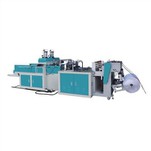
The first and most critical step in selecting equipment is defining your core production needs clearly.
• Bag Type Definition: Identify the primary bag type you will produce, such as flat-bottom bags, T-shirt/shopping bags, or 自立 (自立型) bags. Different bag types require specialized equipment configurations; for example, T-shirt bags need integrated cutting and punching units, while自立 bags rely on precision welding mechanisms.
• Raw Material Confirmation: Specify the materials you will process (e.g., PE/PP Plastic Films, non-woven fabrics). Processing techniques vary significantly based on materials: for instance, non-woven bags typically utilize ultrasonic welding, whereas plastic film processing depends on heat sealing technology.
• Dimension Scope界定: Define the maximum and minimum尺寸 (dimensions) of the bags, along with the acceptable film thickness range. This directly influences equipment specifications, with typical film widths ranging from 200mm to 1200mm.
2. Automation Level Evaluation
The level of automation directly impacts production costs, efficiency, and labor requirements.
• High Automation: Equipped with full-automatic control systems, these machines integrate unwinding, forming, sealing, and cutting processes. They are ideal for large-scale manufacturing and stable production.
• Semi-automatic Operation: Common in mid-range equipment, these machines streamline specific stages of production while requiring minimal human intervention.
• Customization Potential: Modern equipment often supports adjustable automation settings to accommodate diverse production volumes and material variations.
Key System Assessments:
• Control System: Prioritize equipment equipped with PLC (Programmable Logic Controller) and HMI (Human-Machine Interface). These offer intuitive operation, easy parameter configuration, and comprehensive fault diagnostics for seamless maintenance.
• Drive System: A full-servo motor control system is the cornerstone of high-speed and high-precision operation. It guarantees unmatched accuracy in bag length control, sealing, and cutting positioning.
• Correction & Tension Control: Essential for complex printing applications. Features like Auto LPC (Linear Position Correction) and Constant Tension Control prevent film wandering, ensuring precise alignment of printed patterns and consistent material positioning.
• Temperature Control System: An efficient PID temperature control system ensures stable heat sealing. It delivers secure, aesthetically pleasing seals while preventing overheating, which is critical for maintaining product freshness and packaging integrity.
考察厂家与服务 (Evaluating Manufacturer & Support)
Beyond the initial purchase, long-term collaboration and service reliability are paramount. Look for manufacturers with:
• Customization Capability: A dedicated team with expertise in adapting to fast-paced packaging demands. They should offer tailored non-standard configurations to meet your specific future packaging needs.
• After-Sales Support: Ensure they provide a comprehensive after-sales system, including a one-year warranty, professional technical training, ready access to spare parts, and guaranteed fast fault response times.
• Enterprise Reputation & Strength: Verify the manufacturer's technical R&D capabilities (patent count), industry track record, and successful case studies. Pay special attention to their applications with well-known enterprises in the industry, which reflects their credibility and professionalism.
综合成本核算 (Comprehensive Cost Analysis)
It's critical to look beyond the sticker price. Calculate the Total Cost of Ownership (TCO) to assess long-term value:
• Initial Investment: Includes equipment purchase, transportation costs, professional installation, and debugging fees.
• Operating Costs: Consider long-term energy consumption, the number of operators required, and daily maintenance costs.
• Return on Investment (ROI): Evaluate the equipment's production efficiency and stability. While a higher initial price might seem costly, equipment with higher efficiency and low defect rates often delivers superior long-term cost benefits and a quicker return on your investment