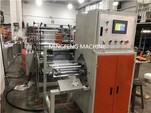
How to Adjust Tension of Bag Making Machine According to Materials
Adjusting the tension of a bag making machine according to different materials is a precise operation that combines material properties, equipment performance, and production experience.
The basic principle is: Tension is not better when it is higher, but better when it is appropriate.
You can scientifically adjust tension following these steps and principles.
1. Core Principle: Adjust Based on Material Characteristics
Physical properties of different materials (such as tensile strength, modulus of elasticity, thickness) vary greatly, so tension settings must be customized.
• Hard materials (PET, BOPP)
◦ Features: Good rigidity, not easy to stretch or deform, can withstand relatively high tension.
◦ Suggestion: Use relatively high tension to ensure flatness and stability during high-speed operation.
• Soft materials (PE, CPP, PVC)
◦ Features: High ductility, very soft, easy to stretch and become thin under tension.
◦ Suggestion: Must use low tension control. Excessively high tension will cause the film to narrow and thin significantly, and even cause loose rolls like "bamboo joints" after winding.
• Special materials (ultra-thin film, functional film)
◦ Features: Extremely sensitive to tension.
◦ Suggestion: Require high-precision, low-fluctuation micro-tension control.
2. Operation Steps: From Theory to Practice
Step 1: Theoretical Estimation and Reference of Empirical Values
Before startup, determine an initial value based on experience or simple calculation.
• Empirical method: Set an initial range according to material type and thickness.
◦ Example: PET film usually uses 2–5 kgf tension; PE film uses 1–3 kgf.
• Calculation method: Theoretically, tension T is proportional to modulus of elasticity E , cross-sectional area A (width × thickness), and elongation.
Formula: T = E \times A \times \Delta L / L .
This shows that wider and thicker films need higher tension.
Step 2: Differentiated Settings in Different Zones
Tension is not the same along the production line. It usually follows the rule of "lower front, higher rear" or is set differently for each station.
1. Unwinding zone: Low tension, mainly to overcome inertia and feed film smoothly.
2. Trailing / processing zone: Critical zone, requires very stable tension as the system benchmark.
3. Winding zone: Most complex. Usually use taper tension – tension decreases as roll diameter increases, to ensure uniform tightness and avoid "chrysanthemum patterns" or core crushing.
Step 3: Dynamic Adjustment and Fine-Tuning
After startup, adjust dynamically according to actual conditions.
• Adjust with speed: Increase tension during acceleration to prevent slack; decrease during deceleration to avoid excessive tension from inertia.
• Observe film surface:
◦ Wrinkles or sagging → tension too low → increase properly.
◦ Over-tight or obviously narrowed film → tension too high → decrease properly.
3. Tools and Assistance: Using Tension Controllers
Modern bag making machines are usually equipped with special tension controllers (magnetic powder brake, servo motor drive, etc.).
• Set percentage (%) or actual force value (N / kgf) on the controller.
• Use functions like taper setting and maximum roll diameter setting for intelligent automatic tension adjustment.
4. Key Notes
• Adjust gradually: Make small changes each time, observe the effect, then adjust further.
• Check mechanical condition: Ensure all guide rollers rotate flexibly and are parallel.
• Environment: Temperature and humidity affect film properties and tension – pay attention to environmental changes.