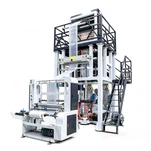
Factors Affecting the Output of Double-color Strip PE Film Blowing Machine
1. Equipment Hardware (Core Factor)
1. Specifications of twin extruder screws
The diameter of the two screws directly determines the discharge volume. Models like SJ40×2, SJ45×2, SJ50×2 and SJ55×2 deliver higher hourly output with larger screw size. Due to the complex internal runner of the double-color co-extrusion die head, the production capacity is 5%–10% lower than that of a standard single-color film blowing machine with the same screw specification.
2. Motor power
Larger power for main extruder motor and traction motor allows a higher upper limit of screw rotating speed and faster material extrusion. Undersized motors will trigger overload speed reduction and restrict maximum output.
3. Die head structure and runner smoothness
The narrow shunting gaps of the special double-color strip co-extrusion die head easily get blocked by carbon deposits or color pigments, increasing melt flow resistance and cutting down production directly. Insufficient cooling from the air ring and air duct will cause unstable film bubbles, forcing operators to slow down the machine.
2. Raw Material Factors (Largest Daily Fluctuation)
1. Type of plastic raw material
- Virgin LDPE (Low Density Polyethylene): Best fluidity and highest output
- LLDPE and HDPE: Higher melt resistance, capacity drops by around 10%
- Recycled pellets or material filled with calcium carbonate: Poor fluidity and excessive impurities reduce output by 20%–35%, and may clog the double-color die head frequently
2. Proportion and quality of color masterbatch
A high dosage of low-fluidity color masterbatch will slow down the overall melt flow rate. Unbalanced color ratio (e.g. 9:1) causes blocked discharge on one extrusion channel, so the whole unit has to operate at a lower speed.
3. Dryness of raw pellets
Moist and damp pellets create bubbles and holes on the film bubble, which requires lower extrusion speed and greatly lowers actual hourly output.
3. Technical Requirements of Finished Film
1. Film thickness
Thicker film supports faster extrusion and higher output. Super thin film for shopping bags (0.008~0.02mm) needs slow and stable bubble forming with the lowest productivity, while thick striped mulch film or tablecloth film can run at full rated speed.
2. Film width
On the same machine, narrow-width film yields higher output than wide-width film, as wide rolls demand stronger cooling airflow and limited traction speed.
3. Appearance standard for striped uniformity
Strict requirements for straight, evenly sized stripes force conservative settings on screw speed and traction speed, unable to reach full load production. Loose appearance tolerance allows maximum running efficiency.
4. Production Environment & Operation Process
1. Performance of cooling system
Air volume, wind pressure and temperature uniformity of the air ring play a vital role. High ambient temperature in summer causes inadequate cooling, wobbling and sticking film bubbles, resulting in speed reduction. A chiller for forced cooling improves high-speed running stability.
2. Temperature parameter setting
Improper temperature for the barrel and die head leads to incomplete plastic melting or thermal degradation, unstable melt fluidity and inconsistent extrusion, so operators dare not run the machine at high speed.
3. Operator proficiency
Double-color co-extrusion is much harder to debug than single-color film blowing. Inexperienced workers often face uneven stripes, film breakage and folding edges, resulting in long-term low-speed operation with actual output far below the rated theoretical value.
4. Continuous running time
Long non-stop operation causes material buildup on the die head and screw wear, gradually reducing extrusion efficiency. Regular cleaning of the screw and die head maintains stable production capacity.