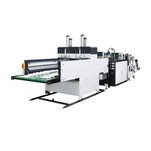
English Translation (Professional & Export-Oriented Version)
In the 2026 market environment, bag making machines equipped with AI functions are typically about 30% to 50% more expensive than standard bag making machines of the same specification.
This is not just a simple addition of hardware costs, but also includes premiums for software algorithms, high-precision sensors, and intelligent control systems. To help you understand this investment more intuitively, I have prepared a detailed price comparison and cost structure analysis.
💰 Price Comparison: Standard Version vs AI Intelligent Version
Taking mainstream fully automatic high-speed bag making machines on the market (such as those for producing supermarket shopping bags or stand-up pouches) as an example, the price differences are roughly as follows:
| Machine Type | Estimated Price Range (CNY) | Core Configuration Differences |
| Standard Fully Automatic Model | 150,000 – 350,000 | Basic PLC control, standard touch screen, mechanical tension control, basic photo-eye tracking. |
| AI Intelligent Enhanced Model | 400,000 – 800,000+ | AI vision inspection system, adaptive tension / temperature control, remote IoT module, digital human-machine interface, predictive maintenance algorithms. |
Note: For highly customized complete line solutions (such as AI linked production lines with automatic feeding and automatic cartoning), prices can easily exceed 1 million yuan.
🧐 Where Does the Extra Cost Go?
The extra amount you pay mainly covers three types of "hidden value":
1. The "Eyes": Industrial-Grade AI Vision System
This accounts for the largest part of the cost increase. Standard machines rely on photoeyes to track registration marks, while AI machines use industrial cameras + edge computing units.
• Hardware cost: High-resolution industrial cameras and dedicated image processing chips.
• Functional value: It can identify defects like uneven seals, trapped foreign matter, and misaligned printing just like human eyes. Any defective product is rejected within milliseconds, preventing waste from entering the packaging process - critical for the food and pharmaceutical industries.
2. The "Brain": Intelligent Algorithms & Adaptive Control
Parameters on standard machines are fixed, while those on AI machines are adaptive.
• Technology premium: Integrated deep learning control algorithms.
• Functional value: When producing temperature-sensitive biodegradable materials, for example, the AI automatically fine-tunes sealing temperature and tension according to slight changes in ambient temperature and film thickness, without repeated manual adjustment by experienced operators. This greatly reduces scrap rates and setup time.
3. The "Nerves": IoT & Remote Services
• Service premium: Built-in 5G / industrial Ethernet modules and cloud services.
• Functional value: The machine sends real-time "health reports" to the manufacturer. Before parts fail, the AI issues alerts (e.g., "Abnormal vibration in main shaft bearing; replacement recommended within 3 days"), avoiding huge losses from unexpected downtime.
💡 Return on Investment Analysis: Is It Really Worth It?
Despite a higher initial investment of hundreds of thousands or even hundreds of thousands of yuan, AI machines often achieve faster payback in the 2026 production landscape:
• Labor savings: Standard machines usually require 2–3 operators (feeding, inspecting defects, packing), while AI machines only need 1 operator for patrol inspection. Annual labor cost savings can exceed 100,000 yuan.
• Reduced material waste: For expensive biodegradable or composite films, AI reduces the scrap rate from 3% to below 0.3%. Material savings can offset the price difference within half a year.
• Access to high-end orders: Many major international clients (e.g., European and American supermarkets, pharmaceutical companies) have made full-process quality traceability a mandatory requirement for suppliers in 2026. Only AI equipment can automatically generate such data reports, helping you secure high-margin orders.
Final Recommendations
If you produce low-value-added general garbage bags or simple packaging bags with high defect tolerance, standard machines remain sufficient.
However, if you manufacture packaging for food, pharmaceuticals, high-end cosmetics, or use expensive biodegradable materials, the AI intelligent version is strongly recommended - the material and labor costs it saves will far exceed the price difference of the machine.