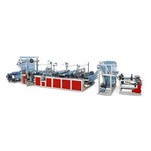
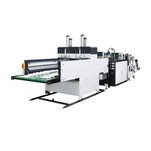
The core of efficient linkage for heat-seal cold-cut bag making machines lies in breaking down "information silos" and achieving seamless "roll-to-bag" flow. This is not merely about connecting equipment, but rather about three-dimensional synchronization of tension, speed, and data.
I. Linkage Logic: From "Lone Soldier" to "Production Line Coordination"
In the traditional model, the bag making machine operates as an isolated "black box." Efficient linkage requires it to function as the "central hub" of the production line, enabling continuous feeding, precise registration, and direct product transfer.
II. Upstream Linkage: Synchronization with the Printing Press ("Speed and Registration")
This is the most critical technical challenge in the linkage, directly impacting the defect rate.
1. Tension Coordination (Prevents Stretching/Wrinkling)
• Independent Unwinding Stand: A separate unwinding unit is configured before the bag maker, acting as a "tension buffer zone" between the printer and the bag maker, preventing the bag maker from running out of material if the printer stops abruptly.
• Dancer Roll Control: Real-time monitoring of web tension allows for micro-adjustments via servo motors, ensuring the web remains taut but not stretched (crucial especially for PE films).
2. Print Registration
• Photoeye Synchronization: A high-precision photoelectric eye (or CCD camera) is installed at the bag maker's infeed to detect the printed registration mark.
• PLC Calculation: The PLC automatically calculates the cutter drop point based on the set bag length, ensuring consistent graphic positioning for each bag (error < ±1mm).
III. Downstream Linkage: "Seamless Integration" with the Packaging Machine
The goal is to eliminate intermediate manual handling and sorting.
1. Conveying and Counting
• Belt Conveyance: Cold-cut bags are conveyed via belt to the packaging machine's hopper.
• Synchronization Signal: The bag maker sends a pulse signal to the packaging machine for each completed bag, triggering the packager to pick or count.
2. Sorting and Stacking
• Automatic Stacking: The bag maker outlet is equipped with an automatic stacking mechanism, neatly piling bags in set quantities (e.g., 100/bundle).
• Robotic Pick-and-Place: High-end lines use a robotic arm to directly pick finished bags from the bag maker's outlet and place them into the packaging machine's bag feeding station, achieving fully automatic bag loading.
IV. Efficient Linkage Solutions for Wenzhou-Made Machines
Considering the characteristics of equipment manufactured in Wenzhou, the following two mainstream solutions are recommended:
Solution Type Suitable Scenario Core Configuration Key Advantage
Integrated Printing + Bag Making In-house printing shop, high-volume single specification Independent unwinding stand + Servo tension control + Auto guiding Reduces downtime for roll changes; suitable for T-shirt bags, flat bags.
Bag Making + Pre-made Bag Packaging Machine E-commerce, food packaging plants Conveyor belt + Counting sensor + Stacker Bags go directly into packaging, eliminating intermediate manual sorting.
V. Technical Selection Recommendations
To achieve efficient linkage, equipment must have the following hardware foundations:
• Full Servo Drive: Only servo motors enable precise electronic cam synchronization; pneumatic systems struggle with speed matching.
V. Technical Selection Recommendations
To achieve efficient linkage, equipment must have the following hardware foundations:
• Full Servo Drive: Only servo motors enable precise electronic cam synchronization; pneumatic systems struggle with speed matching.
• Standard Communication Interface: Machines should have reserved RS485 or Ethernet ports supporting Modbus protocol for easy data exchange with MES systems or upstream/downstream equipment.
• Buffer Capacity: The unwinding stand capacity should be ≥ 2 rolls, ensuring the bag maker doesn't stop when the printer changes rolls.
One-sentence summary: The essence of efficient linkage is "the bag maker waits for material, not for the machine"-using speed following and tension buffering to make the entire line run like a single machine.