

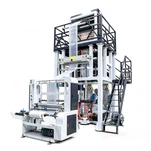
Walk into any plastic packaging factory and you'll see a long production line: funnel-shaped hoppers at one end, into which small plastic particles "clatter"; at the other, a slowly rising "bubble," with the top flattened and rolled up until it's a clear film. The whole process may seem simple, but behind it lies a clever physics and chemistry 'magic."
Step 1: Particle preheating-transition from solid to melt
The protagonist of the production line is a polymer particle called polyethylene (PE) or polypropylene (PP). They were just small, hard plastic particles the size of rice grains. To film them, the first step is to"soften" them.
The particles are fed into a a screw extruder-a long spiral metal screw that rotates and transports in a heating cylinder. The heating coil is wound around the outside of the cylinder and the temperature is usually controlled at around 160 to 220C. With the combination of heat and helical shear force, the normally regular polymer chains begin to loosen and slide, and the solid particles melted into a viscous melt, like chocolate in a hot pot. temperature control at this stage is crucial: if the temperature is low, it does not plasticize and is difficult to extrude; if the temperature is high, it damages the polymer chains, making the film brittle and yellowish.
Step 2: Melt 'blowing' -how the blow is formed
Molten plastic is being screwed into the front of the extruder. In the center of the nose was a round mold from which the melt is pressed into a cylindrical "billet" - in this case a soft, thick-walled cylinder.
The real magic moment has arrived: as soon as the billet left the mold, the machine introduces a precisely controlled flow of air from inside the cylinder core. The airflow swells the hose, causing it to expand and thin rapidly like a balloon. At the same time, a set of traction rollers is clamped to the film cylinder and pull upward at a constant speed. Thus was born, a constantly rising and growing "plastic bubble," as the industry calls it.
Step 3: Cooling and Molding-From Balloon to Film
The inflated membrane bubbles higher and higher, and the tube wall thinner, gradually extending from a few millimeters to a dozen millimeters or even micrometers. In order to prevent bonding and deformation, the film bubble needs to be cooled by cooling air rings, which are quickly cooled by uniform cold air, allowing the melt to solidify again.
At the top of the film bubble, a pair of herringbone clamps gradually flatten it out, and then a traction roller collects it into a double-layer film. Finally, the winding device neatly rolls the continuously produced films into a single roll for subsequent printing and bagging processes. The uniformity of film thickness depends largely on the combination of the "inflation ratio" (the ratio of bubble diameter to mold diameter) and the pull speed, which is the master's most important operating skill.
Little Movies, Big World
Why, you might ask, do we "blow" it into a cylinder instead of squeezing it straight into a flat film? That's the beauty of blowing film. The inflation process allows the polymer chains to be completely oriented and stretched horizontally and vertically, resulting in a stronger and more uniform film thickness. It also has a cylindrical construction-with a slight cut and heat seal that can be made directly into a bag, eliminating the need for sewing.
From snack bags to supermarket plastic bags to courier bags bags and agricultural plastic, almost everyone these days relies on this seemingly unremarkable line of blow-outs. Ordinary plastic particle quietly carry every aspect of our daily lives through a magnificent transformation from "one" to "one" through a series of processes such as heating, squeezing, expanding and cooling.
plastic transformation : how the blown film machine blows particles into a film
Sep 01, 2026
You May Also Like




Send Inquiry
Categories
Contact Us
- Mob: +8615167807851
- mingfengmachinery@163.com
- Add: Jielutou Industrial Zone, Ruian, Zhejiang, China